A Different Kind of Kin(g)dom: A sermon based on Mark 1:14-20

Mark 1:14-20

I mentioned last week that of the gospels, John has taken me the longest to connect with. This week we find ourselves in Mark, though, and Mark has long been my favorite. Maybe gospels are like children and we’re not supposed to have favorites, but I guess do. (Have a favorite gospel, I mean, not a favorite child.)

Mark’s gospel has a fast pace to it. For the grammarians among us, there are a lot of sentence fragments that start with “And then…”. The versions of shared stories that appear in Mark are typically short and lack some of the editorial detail or theological explanation. And yet, that doesn’t mean there isn’t a theological thread through Mark; it just means we get to piece it together from the way the stories are told and how the whole book is put together. I love this responsibility that is given to us, the readers, disciples of Jesus, the body of Christ. 

The story we explore this Sunday, the beginning of Jesus’ Galilean ministry and the calling of his first disciples (Mark’s version), gives us a huge hint about Mark’s theology and ultimate message about who Jesus is, why he lived, died, and lives again, and what it means to be his followers, his disciples.

The worship video for this sermon is available here. (The sermon is really from Mark, not Matthew, no matter what I said when introducing the scripture.)

Kin(g)dom Sight: A sermon for January 14, 2024, Martin Luther King, Jr Weekend, based on John 1:43-51

The worship video for this sermon is available here.

John 1:43-51

Photo by wendel moretti on Pexels.com

It has taken me a while to warm to up to the gospel according to John. And by a while I don’t mean a few days this week in preparation for worship today. I mean like years, decades. Maybe it’s taken that long for my brain that was trained in the sciences to finally open up to the poetry and symbolism and mysticism in the fourth gospel. But I’m coming around to. Where I used to get frustrated, thinking, “Just say what you mean.” Now I’m more intrigued by how many different things are meant by the one thing that is said.

Continue reading

A Baby Story: A sermon based on Luke 2:1-20 for Christmas Eve

Luke 2:1-20

In the late 1990s and early 2000s there was a TV show on The Learning Channel called “A Baby Story.” This 30 minute documentary-style show (I use that term loosely) would feature a family preparing to welcome a new baby. Each episode included interviews with parents, grandparents, siblings, and friends. Usually there was a visit to the doctor for a pre-natal visit. And then there was some little extra feature to highlight the preparations or celebrations that might be taking place, before the final (significantly edited) footage of the birth.

Photo by Erol Ahmed on Unsplash

When watching this show religiously (which I did), one of my favorite features was when the soon-to-be parent would walk the audience through the packing of their hospital bag.  It feels a little silly now, but I loved watching what people chose for comfort, what they threw in to keep themselves occupied just in case they had time, what they wanted to listen to while laboring, what they carried along for religious devotion, or what clothes they wanted the baby to wear when they were coming home. 

Continue reading

Keep Alert: A sermon for the 1st Sunday of Advent,

A worship video of this sermon is available here.

Isaiah 64:1-9
Mark 13:24-37

In case you’re wondering if you’re having deja vu, yes, this is, indeed, our fourth apocalyptic text in as many Sundays.  Three weeks ago there were quite a few similarities in the “punch line” of keep awake, when we heard the story from Matthew of the ten bridesmaids waiting for the bridegroom who was delayed. Then in the next two weeks there were parables – one of the talents that offered a vision of the kindom of God where the conventional economic system is turned upside down, and another of the sheep and the goats where the needs of the “least of these” are centered. These stories may not feel like “apocalypse,” but they are depictions of how we are called to live when we know that there is going to be a great reckoning and setting things right, but it hasn’t happened to completion just yet.

Photo by Matt Botsford on Unsplash

And now here on the fourth Sunday in a row, the first Sunday of a new Christian year, the first Sunday of Advent, the season of waiting for this coming of Christ, we have another description of what some call “the end times.” For us Presbyterians, who tend to be known for our orderliness, this is an awful lot of talk about the chaos of the unknown and unpredictable.  And yet, one of the commentaries I read a few weeks ago when thinking about the Matthew passage said “The expectation of Christ’s return is central to Christian living.”¹

Continue reading

Stay Ready – A sermon on Matthew 25:1-13

I was remembering recently a button that used to exist in the solitaire game software that came pre-installed on Microsoft computers. It was known as a “Boss button.” The idea was that if you were playing card games on your computer at work and your boss came by unexpectedly, you could hit this button and a meaningless spreedsheet with meaningless data would take over your screen, hiding the card game.  It was sort of a digital, “Quick! Look busy!” solution. 

The parable we encountered in worship today has a little bit of that “Quick! Look busy” feel to it.  Two groups of bridesmaids in the story have two different ways of waiting while the return of the bridegroom is delayed, leading us to think about what we do when when the “boss” isn’t around. How do we wait when the waiting starts to get longer than we expected? 

A worship video of this sermon is available here, and the manuscript can be found by clicking “Continuing reading” below.

Continue reading

The Gift of the Law – A sermon on Exodus 20:1-17

It’s a common Christian misconception to think the Old Testament is all about an angry, vengeful God, while the New Testament has a monopoly on love and grace. Often people will point to “all those rules and commandments” to support that kind of thinking. In this sermon, we look at the Ten Commandments, where they sit in the story of God’s love for God’s people and how they guide us to live in that love.

Exodus 20:1-17

The manuscript appears below.

Continue reading

A Future with Hope: A sermon on Jeremiah 29: 1, 4-14

Jeremiah, a prophet of God, ministered to the people of the southern kingdom of Judah at the end of the 7th century BCE and into the 6th century. The kings that followed Saul, David, and Solomon by and large had not led the people well, and because of the nations’ idolatry, exploitation of the poor, and oppression of people on the margins, their kingdoms have crumbled under outside pressure.

The reading we will hear today is from a letter Jeremiah wrote to some of the people of Judah who have been taken into exile when the natural consequence of the nation’s sin led to their conquer by Babylon. It’s not totally clear how long they have been in exile, anywhere from 1 to 2 years to 10. It’s long enough for them to wonder how they are supposed to live in this strange time in a strange land, and long enough for false prophets to pop up, those who predict a speedy end to this momentary unpleasantness.

Jeremiah 29:1, 4-14

By the rivers of Babylon—
   there we sat down and there we wept
   when we remembered Zion.
On the willows there
   we hung up our harps.
For there our captors
   asked us for songs,
and our tormentors asked for mirth, saying,
   ‘Sing us one of the songs of Zion!’ 


How could we sing the Lord’s song
   in a foreign land?
If I forget you, O Jerusalem,
   let my right hand wither!
Let my tongue cling to the roof of my mouth,
   if I do not remember you,
if I do not set Jerusalem
   above my highest joy. 

Continue reading

Are all welcome? – A sermon based on Acts 8:26-39

Manoel Amaro, CC BY-SA 3.0 https://creativecommons.org/licenses/by-sa/3.0, via Wikimedia Commons (cropped)

Acts 8:26-39

I wonder how the eunuch from Ethiopia came to visit the temple Jerusalem. We don’t know exactly what his relationship is with the faith of most temple worshipers, but somehow he came to be curious enough about the temple and what that takes place there, that he decided to travel all the way to Jerusalem to worship there.

Continue reading

Crossing Chasms

photo by cea+
on flickr, used with permission of Creative Commons Attribution 2.0 license

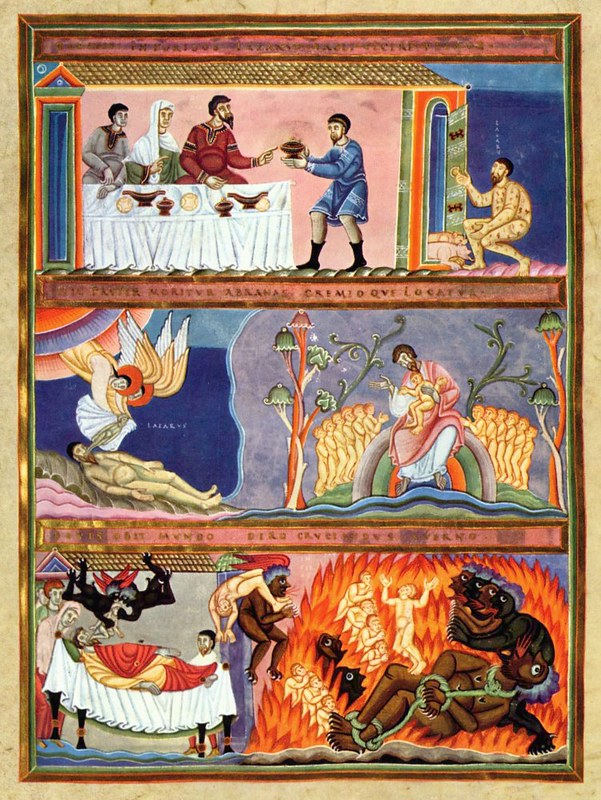
Luke 16:19-31

The rich man in Jesus’s story is in quite a predicament, isn’t he? Things are not going as he expected them to at all. Having arrived in Hades, not so much the heaven and hell of traditional Western Christianity, but a general place of all the dead, he is not getting the treatment he expected.  Understanding riches to be a sign of God’s favor he seems surprised to be tormented by flames while Lazarus, the man who was clearly cursed with poverty and illness, is being comforted in the bosom of Abraham. The rich man doesn’t miss a beat, though.  He knows just want to do. He will order someone to fix his agony for him.

Continue reading

The Way of Truth

The video of this sermon being preached appears at the bottom of the post.

Luke 3:1-22

This morning’s reading from the gospel according to Luke, his account of the ministry of John the Baptist and remarkably brief telling of the baptism of Jesus, starts with a litany of governmental leaders. Luke tells us who all the powerful people are in the Roman world and in the regions that will be important in Jesus’ ministry – Judea, and Galilee, and more. He mentions by name not only the governmental leaders of the leaders of the Jewish community who work in some relationship with the governmental leaders, a relationship that will become important to remember several years later when all of these empire leaders conspire to put Jesus to death.

Luke starts with this time stamp and this recognition of the “powers and principalities,” but then very quickly pivots and in the same sentence says the word of God came not to these, but to John, the son of Zechariah, who was in the wilderness. The word of God, Luke is telling us, the words that John delivered, the ministry he was about, is for and among the people of God. John’s words that we heard, and will hear more about, are kind of harsh, right? They do not tiptoe around and make the people feel good. They do not allow the people who hear them simply to cast judgement on the evil empire or those corrupt rulers in Rome (or liars in Washington) and absolve themselves from any guilt. They confront us, and they call us to listen up and pay attention. This repentance stuff starts at home.

Continue reading