Psalm 107:1-3, 23-32
Mark 4:35-41
A few weeks ago in our weekly e-mail that goes out on Thursday afternoons I set up a framework for thinking about the three stories in Mark’s gospel that we have covered beginning on June 9. It hasn’t really been a series in the “5 keys to faithful relationships” kind of way, but together these three stories, and therefore these three sermons have offered us ways to consider reactions to the news that in Jesus the kingdom (or kindom) of God is near.
As we looked at the story of Jesus being hunted down by religious scribes who wanted to destroy him, of the way his own family thought he was out of his mind, the question before us, in response to *that* kind of kindom was “What if I don’t like the disruption it causes?”
When next we turned to parables about seeds hidden in the ground or too small to be significant we considered of the kindom of God, “What if I can’t see it?”
And two and a half or three weeks ago when I was thinking about the story for today, I was wondering about the disciples’ worry that Jesus didn’t care about the storm and their lack of faith, and I thought maybe they were doubting the kindom with a question along the lines of “What if it isn’t strong enough?”
But… well… best laid plans. As Pastor Michelle pointed out a few weeks ago, sometimes the sermon we thought we were going to preach on Monday or Tuesday when we pick hymns and write prayers isn’t the sermon we end up with when we write on Thursday or Friday (or Saturday or Sunday morning).
This one isn’t dramatically different from the framework I set up a few weeks ago, but that question “What if the kindom isn’t strong enough?” just doesn’t really fit a closer reading of the story. It might be more appropriate for the story as Matthew and Luke tell it. This same event occurs in all three of these gospels, but with slightly different details.
In Matthew and Luke when the storm rages and the boat starts to take on water the disciples do more than ask Jesus why he’s calm enough to sleep. In Luke they cry out with distress “Master, master, we are perishing!” In Matthew they beg Jesus to do something. “Lord, save us!” These are the cries of disciples who are desperate to know if the power Jesus has is enough to do anything about their precarious situation.
I’m not sure the disciples in Mark even really expect Jesus to do anything. This is the gospel where the disciples notoriously never understand who Jesus really is, how powerful he is. God bless them. They feel really familiar to me. This the gospel where none of the disciples, not even Peter whose bold statements we’re used to hearing, none of the disciples ever actually grasp the truth of what God said at Jesus’ baptism, “You are my Son, the Beloved.” None of them can quite get to a point of faith where they can declare that truth with confidence. The demons Jesus casts out recognize it. The evil spirits he exorcises say it. But the only human being who ultimately grasps the full truth of who Jesus is, his relationship to God, the reason God’s kindom does, in fact, come near in him, is a Roman centurion who witnesses Jesus’ death on the cross.
So it probably shouldn’t surprise us that the disciples in Mark ask a very different question, a question much more characteristic of their general cluelessness, of their lack of understanding of who Jesus is and what he can do. They don’t necessarily ask him for help in the situation. They ask him why he isn’t worried. “Teacher,” they start. A sign of respect, but not quite the same as “Master” in Luke and definitely not “Lord” in Matthew “Teacher, do you not *care* that we are perishing?”
These disciples are worried. Very worried. And these are the kind of people whose worry we should maybe pay attention to. All of them are from around the Sea of Galilee. They know that storms on the water are not uncommon, and they know, especially the fishermen among the disciples, when a storm is just a storm, and when a storm is a storm to be worried about. If they believe that they are perishing as the waves are beating into the boat and the boat is taking on water, it is time to worry.
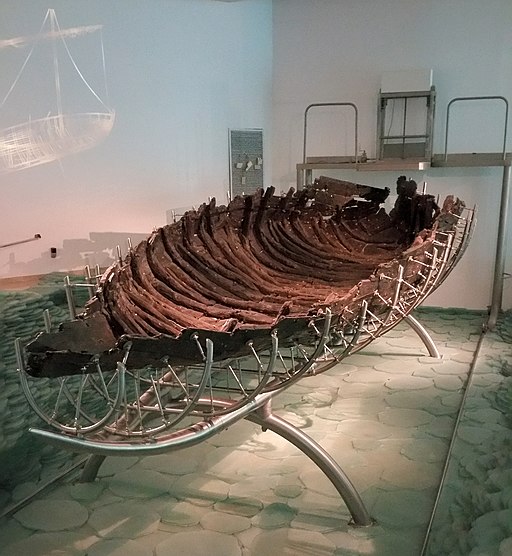
2,000 year old boat dug out from the mud along the shores of the Sea of Galilee; on display in the museum of Kibbutz Ginosar located north of Tiberias
Konrad Summers from Santa Clarita (Valencia) , California, USA, CC BY-SA 2.0 https://creativecommons.org/licenses/by-sa/2.0, via Wikimedia Commons
I wonder at what point in their panic they noticed he was missing. I imagine bucket brigades trying fruitlessly to scoop water out of the hull of the boat. Sailors and passengers trying to push the encroaching sea off the deck and back where it belongs. With the wind ripping through sails that are now flailing about, rain coming from every direction when the wind gusts, the lightning flashes only illumine the sky periodically and not long enough to clearly make out who is who and who is where.
But at some point in the midst of all this, someone notices Jesus isn’t around and eventually they find him SLEEPING, curled up on a cushion, as if nothing at all is going on.
These aren’t disciples who are wondering if the kingdom of God is strong enough. If these disciples have time to wonder about the kingdom of God, they may be wondering if it matters at all.
The sea in their minds, even without a storm raging, carried great weight, instilled great fear. In the stories and belief systems that were ancient even in biblical times, the sea was the source of chaos (as in the exodus from Egypt) and destructive powers (as in the floods of Noah), the dwelling place of unimaginable monsters (like the leviathan in the Psalms) and demonic forces that could overpower creation. So here they are in the middle of a storm in the middle of the sea, and their teacher who has been talking non-stop about God’s kindom for days is sleeping.
How could he? With the boat being engulfed by water and presumably spirits, why isn’t he worried not only for their physical safety, but also for their spiritual safety? What good is the nearness of the kindom of God if it doesn’t matter in the most dangerous of situations?
Yet like the sea brings to mind seas of chaos, Jesus’ slumber is also a motif common not only in the older testament, but in other ancient Near East stories. A slumbering God is a God with absolute dominion over the universe. It’s a God who doesn’t need to worry about what happens while they sleep, because they know they they have complete control over whatever it is.
Jesus’ sleep, therefore, isn’t a sign that he doesn’t care, as the disciples suppose. Instead it is a sign of his complete care and his total trust that even in a storm, even when the demons are restless, even when perishing looks to be a real threat, that God is sovereign over all. It is a trust borne of confidence, and confidence comes from knowing what is true – truer than any fear, truer than any worry, truer than any threat. The sea will not win; demonic forces will not be triumphant. God is in control. God who has been bringing order out of the chaos of the seas since the very beginning of creation, God who has silenced the thundering oceans since the times of Jonah, God who even in the disciples’ own presence has rebuked demons and cast them out, this God is in the boat. Just as Jesus said, the kindom of God is near.
Jesus can sleep because Jesus holds such full-bodied, full-spirited trust in God’s goodness and presence that even when the boat is being tossed, even when it’s starting to take on water, Jesus knows that there is nowhere that boat can sail, no wind that can beat them, no rain that can swamp them, that will take them outside of the providence of God.
This is the good news he himself said his life is all about – the kingdom of God is near.
Notice there is no promise that there will be no storms in life. In fact, there isn’t really even a promise that in Jesus God will calm all of them that do show up on the horizon. Remember, Jesus was ready to sleep all the way through this one!
But the storms are real and to paint them as mere bumps in the road we can ride out with nothing to worry about or to claim that if Jesus doesn’t calm them then we must not be faithful enough does not take them as seriously as they (and we) deserve. But what we find in this story is the never-failing promise that Jesus is with us through the storms – every single one of them – the weather that thunders overheard, the earthquakes that shake underfoot. The diseases that shock our bodies and upturn our lives. The deaths that rattle us to our core. The broken relationship that tear at our hearts. The loss of meaningful employment that feeds our families. The threat of unmitigated climate change. The turn toward nationalism and the abuse of religion in its support. Jesus is with us in the storms, and his presence and his power is stronger than all of them.
“What if the kindom of God isn’t strong enough?” is the question I thought this sermon might address, but that question, pardon the pun, was missing the boat altogether. We know it’s strong enough. It was strong enough to create all that is, seen and unseen, with the power of a word. It was strong enough to free the Hebrew people from slavery. It was strong enough when David battled Goliath. It was strong enough to carry Elijah off in a chariot of fire. It was strong enough to bring Mary to carry her son Jesus. It was strong enough to cast out demons in the crowds that followed Jesus. It was strong enough to overcome the forces of death, even death on cross.
No, the better question to ask, is “If the kindom of God is near, what am I going to do about it?” What are we doing to do about?
How will we shape our lives for it?
Will we scramble in fear at the storms that threaten or will we trust in what we know is true? That we are never outside the reach of God’s steadfast love.
Will we stand with Jesus at arm’s length wondering if he really is who he says he is – the Son of God, whom even the wind and sea obey? Or will we turn in thankful obedience, too, to rest in his faith, to slumber under his sovereignty?
Will we let our of what is unknown, what seems hidden, what moves with chaotic forces in the world, overcome us? Or will we lean into the faith of Jesus and be a part of building his kindom of justice, love, and peace?
Picture credit: Konrad Summers from Santa Clarita (Valencia) , California, USA, CC BY-SA 2.0 https://creativecommons.org/licenses/by-sa/2.0, via Wikimedia Commons
 For Some Reason