This worship video for this service is also available on the Fox Valley Presbyterian Church YouTube channel.
One of the defining features of The Wizard of Oz, the movie from which we’re drawing illustrations of the spiritual journey this Lent, is the switch from sepia toned story-telling to the brightly colored scenes that takes place as Dorothy walks out of her farmhouse, displaced from Kansas, into the magical garden of the Munchkinland town square. Gone are the monochromatic brown tones, and our movie and TV screens are flooded with all kinds of color – from the yellow road, to the green leaves, to blue skies and multi-colored flowers.
(One thing a few folks have pointed out to me is that if your viewing of The Wizard of Oz started with the TV screenings anytime between the 1950s and maybe mid-1980s, you may have never known about this switch. I grew up with mostly color TVs, but those who only had black and white sets missed this transition that the earliest audiences saw in the theater and later audiences could see at home. That had not occurred to me before!)
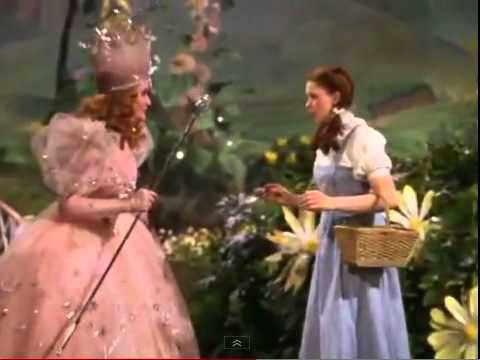
After she walks through the garden a bit, wondering if she’s in Kansas still or maybe over the rainbow, an iridescent pink bubble begins to float onto the scene. Appearing larger as it descends to the ground, eventually it dissipates and reveals Glinda, the Witch of the North, standing before Dorothy. Wearing a puffy pink ball gown, covered in tulle studded with crystals and sequins, poofy sleeves, and long satin gloves, atop her head a sparkly crown, about a foot tall and in her hand is a glittery star-topped scepter, she offers the first words spoken to Dorothy in Oz.
“Are you a good witch or a bad witch?”
Everything about Glinda is designed to signal to an audience steeped in majority-culture symbols that she is a good and kind character. Dorothy need not be afraid. But her question reveals that this may not be true of everyone. The conversation between Glinda and Dorothy continues, and Dorothy insists she is not a witch at all, an answer that doesn’t satisfy Glinda. So she sets about trying to figure this out for herself. Ultimately she determines that since Dorothy, by virtue of the placement of her house, has killed a bad witch, she must therefore be a good witch.
Good witches and bad witches. Good people and bad people. Is it really that easy?
As human beings we sure do like to draw lines to make these kinds of categories. It’s an election year. I don’t have to spend much time trying to come up with examples. Turn on your TV, answer your phone, check your text messages. Someone is trying to convince you – there are good candidates and bad candidates. Also, there are good people and bad people. As it turns out good candidates are on the side of good people, and bad candidates are on the side of bad people. The decision is easy, they say. You don’t want to be on the side of bad people.
Most of us probably like to believe that we are above such tactics, that we can see right through them, but I think they are based on something seems to lie deep inside all of us – this worry, this anxiety that we might not make the “good witch” cut.
A much earlier good witch/bad witch story also takes place in a technicolor garden – not Munchkinland this time, but Eden, in the early chapters of Genesis. In the origin story of humanity, an anthropomorphized God, molds a human being from the clay of the ground. The divine one breathes into the nostrils of the new creation, and at its first breath, its life begins. Then God proceeds to plant a garden with every tree that is pleasant to look at and good for food, a tree of life, but also a tree of the knowledge of good and evil. The human is commanded, “You may freely eat of every tree of the garden; but of the tree of the knowledge of good and evil you shall not eat, for in the day that you eat of it you shall die.”
Well, we heard and we know how well that went. The human beings couldn’t handle it. A serpent out to trick them unpacked that command a little more and convinced them that what had been forbidden actually sounded pretty good. Knowing the difference between good and evil is a characteristic of God, and being like God can’t be a bad thing, can it? It’s a pretty convincing argument, isn’t it? I think I can get there myself. I’m supposed to do good, so it would help to be able to compare that good I think I’m supposed to do with the bad that could be my other option. But it’s not too hard to go from that kind of of thinking to the next step, which is “I’m supposed to do good and be good, so I should probably figure out who does bad and is bad, so I can avoid that and them.”
And here’s where the wheels start to fall off….
We like the order of the categories of good and bad, and having a simple dualistic systems feels like it makes things easier. With a list of acceptable actions or behaviors contrasted with a list of those that are unacceptable, there are no questions. There is no wondering. There is no hard work of navigating grey areas- like can a witch even be good if the witch got to be good by killing a bad witch? Having a dualistic good/bad system takes all the grey areas away by inserting litmus tests that define what is good or bad at every decision point, litmus tests that very quickly turn into a way to judge ourselves and others.
When we start to take the job of judging good and bad into our own hands, for most of us there is tendency to find a way to make sure that we end up on the good side, often by contrasting ourselves to people we would judge to be on the bad side. It feels more sure, we can feel more sure and certain of our welcome in God’s kindom, our salvation even, if we can see in a concrete way how we make the cut and others do not.
My mom once told me of her experience trying out for her high school dance team. She went to the clinics to learn the dances. She practiced at home and with friends. She auditioned in front of coaches and veteran dancers, and then the night of the announcement of the new team she went to the school to check the results. They were posted on a bulletin board with the list of every young woman who had tried out ranked in order of their audition scores. After about 15-20 names there was a thick black line drawn between two dancers. Everyone above the line was in; everyone below the line was out. Or, as I imagine it felt to the young women – everyone above the line was good; everyone below the line was bad.
Consciously or not, I think a lot of us have a similar view of God’s love based on our scores of being good or bad. What is good enough to stay above the line? What is good enough to make the cut? Or even what is good enough to be just right above someone else? Because like the joke about running away from a bear – you only have to be faster than one person – if God’s love and our salvation is based on being good enough, we only have to be better than the person who won’t make the cut.
But this judging – this was exactly what God doesn’t desire for humanity. This is exactly why God does not want us to ingest the ability to judge. Doing so artificially limits God’s love, which is limitless. Doing so sets humanity against each other, when God’s desire is our unity. Doing so substitutes our judgement for our creator’s judgement after our creator looked at humankind made in the imagine of the divine and called us very good.
We have been created good and God’s deepest desire is to remain in relationship with us, even when we turn from our goodness, even when we substitute our own judgement for God’s judgement when looking at ourselves and others – which we do all the time. The Apostle Paul famously wrote about his struggle with this tendency to do not what he knew was right, what is desired by God, but to follow his own judgement. In his letter to the Romans he said, “I do not understand my own actions. For I do not do what I want, but I do the very thing I hate, “ and again, “for I do not do the good I want, but the evil I do not want is what I do. Now if I do what I do not want, it is no longer I that do it, but sin that dwells within me.”
In Reformed theology, we call this “total depravity.” Now individual Christians may find different degrees of truth in this doctrine (even none at all), but the idea is that while we were created good by God, the difference between creator and creature is that we tend to turn away from good. We tend to want to eat the fruit of the tree of knowledge of good and evil. We tend to want to step into the role of God, which is not our role, and when we do that we tend to mess things up – for ourselves, for others, for all of creation. In fact, in a strict understanding of total depravity one would say there is nothing we can do on our own to choose and enact good; every effort is tainted by some sin, unless it is God who is working through us. The dichotomy of pure good and pure bad falls apart.
This more nuanced understanding strips away the false narrative that there is anything as simple as good witches and bad witches, good people who are in and loved and saved and bad people who fall outside of God’s grace. It’s not as simple as that, and in the complexity is the good news. In the complexity is the room for God’s love to be at work in our lives and in our world. In the complexity is the possibility for grace to come in and, in the words of the psalmist, cover our sin and forgive our guilt.
The psalmist writes from this perspective, recognizing the weight of unacknowledged sin. While she kept silent about her transgression, her body wasted away. While he lived in deception about his iniquity, it felt as if a hand was heavy on his life and his strength was dried up. But when they acknowledged their failing, when they put down the job of judging self and others, when they restored the right relationship between creator and creature, the guilt of their sin was forgiven.
“Are you a good witch or a bad witch?”
Maybe the best answer is “yes.”
We have been created by God in God’s good image, called good, made for good. And yet we are not God; we are not capable of that pure goodness on our own. Acknowledging this frees us from the burden of judging ourselves and others in a way that replaces God’s love for all creation with our self-centered desires. So by God’s good grace and promise of deliverance from cycles of destruction, divine good can bring us together to work through us, sent out to love in God’s name. Amen.
 For Some Reason